Induction Sealer Line Integration
Adding rotary accumulation around an existing corner of a pharmaceutical line so short stoppages stop shutting down the whole line.
- Employer
- CHL Systems
- Role
- Design Engineer
- Industry
- Pharmaceutical
- Period
- 2019
- Scale
- Retrofit around an existing 90 degree corner, two new conveyor frames plus a rotary accumulation table
The problem
This pharmaceutical line had no buffer, so whenever one machine stopped, everything upstream and downstream stopped too. A two minute fault turned into full line downtime. The fix was accumulation: a rotary table that gives product somewhere to go when the next machine pauses, so the line absorbs short stoppages instead of passing them along.
Working between existing equipment
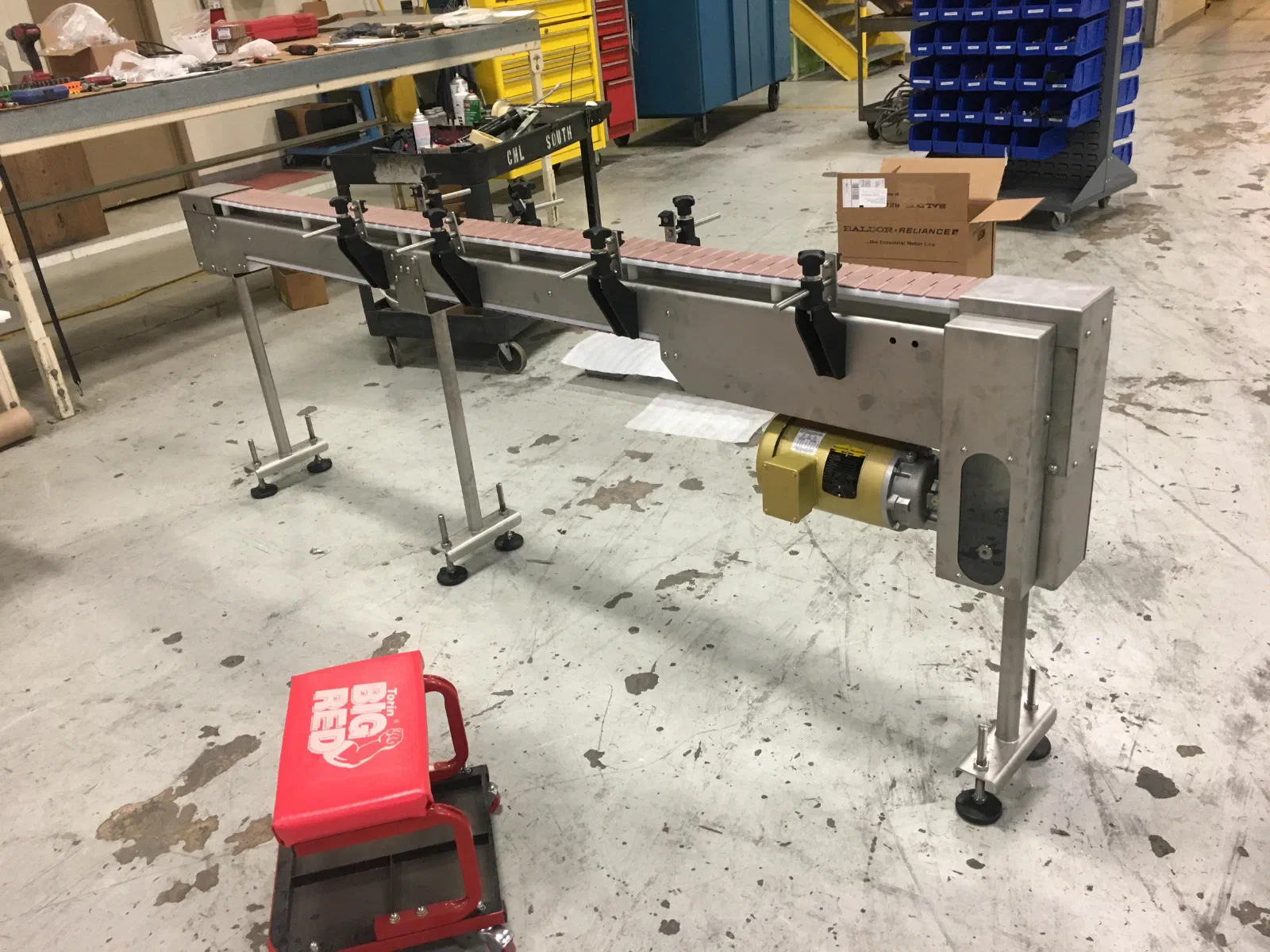
The induction sealer was already in the plant, so the job wasn’t installing a new machine. It was integrating between existing equipment that already had its own footprint and its own product entry and exit points. We cut the existing conveyor at both ends of a 90 degree corner and dropped in two new stainless frames. The accumulation table was repositioned tangent to both new conveyors and modified to accept the new infeed. Cutting into a running line like this means every dimension is measured rather than assumed, and the plant has to be able to run again at the end of the shutdown.
The details
The new frames have UHMW wearbars, guide rails with swivel guides, a transfer plate, and a chain guard, along with a catenary catch for chain slack and a reject bin. The detail I’m happiest with is small: the drawings call for grease extension lines to be installed before the equipment goes in. In a tight retrofit, bearings end up where nobody can reach them with a grease gun, and a bearing that can’t be reached doesn’t get greased.
Opportunities and struggles
Nothing went wrong on this one. It was a well-scoped retrofit into a line we understood, and it went in as designed. Not every project produces a dramatic story, and I think it’s worth being honest about the ones that simply worked.
Specific skills
- SolidWorks
- collaboration with in-house machine and weld shops
- integrating new equipment into an existing line
- accumulation and line buffering
- cutting into and re-terminating live conveyance
- guide rail and product handling design
- designing for maintenance access